What it's about


The way we do business has consequences. With today’s resource-intensive and fossil-fuel based economy, humanity is that it was destroying its own foundations for life. This realisation was already the basis for the 1987 sustainability agenda. Its goal is to ensure a high quality of life in the 21st century – in a radically changed world and a new era of the ‘Anthropocene’.
We are living in a time that is incomparable to anything within the last 10,000 years. It is a time that confronts humanity as a whole with the rapidly eroding state of its ecosystems and habitats. This is a new reality.
It has often been labelled the ‘Anthropocene’, as humanity (anthropos: ancient Greek for human) is comprehensively transforming the ecological living conditions on Earth. This is a hazardous endeavour. After all, security of supply depends on natural systems that behave in a reasonably reliable way. Today, however, seven out of nine of these systems have already slipped out of their usual balance. Seven planetary boundaries beyond which further stress entails major risks have been crossed. These include climate, biodiversity and land use. With each additional burden, the risk to the future security of humanity increases.
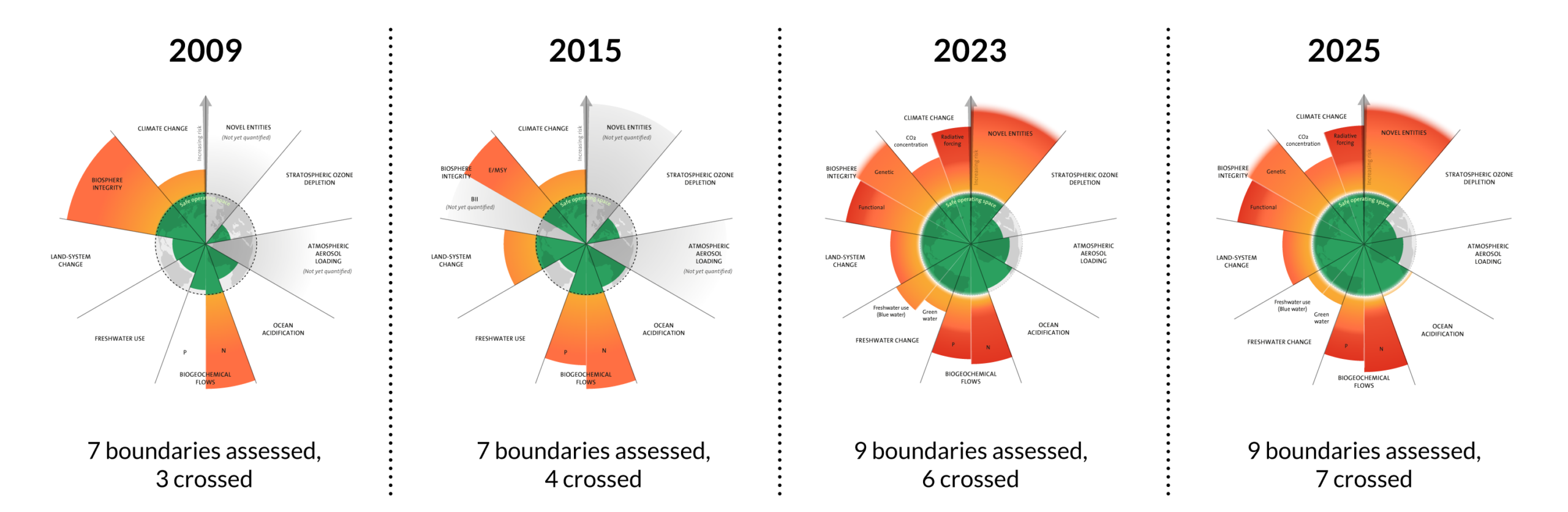
The evolution of the planetary boundaries framework. Credit: Azote for Stockholm Resilience Centre, Stockholm University. Based on Sakschewski and Caesar et al. 2025, Richardson et al. 2023, Steffen et al. 2015, and Rockström et al. 2009 (CC BY-NC-ND 3.0). Click here for the large version.
At the same time, the rapid rise in inequality is putting not only social cohesion but also universal human rights and trust in democratic processes to the test. Technological development, in turn, is increasingly described as an arms race instead of driving new solutions for a good life in the 21st century.
So today’s reality and its habits are neither normal nor particularly stable. We are facing a series of upheavals or tipping points. New forms of production and consumption will be established – by design or disaster.
The fact that much can be gained through better design of economic systems has always been the incentive behind global and European cooperation and is reflected in many political declarations, most recently in the 17 Sustainable Development Goals (SDGs). These goals align well with the wishes of the population, as shown by large-scale surveys on the understanding of prosperity in the dialogue ‘Living well in Germany’ 2017, the ‘Global Commons Survey’ 2021 and the OECD’s ‘Better Life Index’.
In order to achieve these goals, we need a structural reorganisation of the economy towards renewable and circular processes, which is another fact that has been well researched and documented. It is the actual implementation of these changes, the necessary transformation of the political framework, that demands a great deal from democratic societies: not only do we have to let go of the thinking that has created today’s problems, but also of the structures that perpetuate these problems. A great adventure of constructive co-operation.
Quellen
Federal Government. 2024. „Die 17 Globalen Nachhaltigkeitsziele verständlich erklärt.“ https://www.bundesregierung.de/breg-de/themen/nachhaltigkeitspolitik/nachhaltigkeitsziele-erklaert-232174
Federal Government. 2020. „Gut leben in Deutschland.“ https://www.gut-leben-in-deutschland.de/
Gaffney, Owen, and Zoe Tcholak-Antitch. “Global Commons Survey: Attitudes to Planetary Stewardship and Transformation among G20 Countries.“ Global Commons Alliance, 2021. https://globalcommonsalliance.org/wp-content/uploads/2024/01/Global-Commons-G20-Survey-full-report.pdf
Mill, John Stuart. 1848. The Collected Works of John Stuart Mill, Band III, Principles of Political Economy, Teil II
OECD. 2024. „OECD Better Life Index“. https://www.oecdbetterlifeindex.org/
Richardson, Katherine, Will Steffen, Wolfgang Lucht, Jørgen Bendtsen, Sarah E. Cornell, Jonathan F. Donges, Markus Drüke, u. a. 2023. „Earth beyond Six of Nine Planetary Boundaries“. Science Advances 9 (37): eadh2458. https://doi.org/10.1126/sciadv.adh2458
Salk, Jonas, and Jonathan Salk. 2018. A New Reality: Human Evolution for a Sustainable Future. City Point Press. https://www.anewrealitybook.com
Image: Richardson et al., 2023 (CC BY-NC 4.0), German Translation: Sachverständigenrat für Umweltfragen 2023, https://www.umweltrat.de/SharedDocs/Downloads/DE/04_Stellungnahmen/2020_2024/2023_11_Grafik_Planetare_Grenzen.png?__blob=publicationFile&v=9